Be a Harder Target Than Your Neighbors: The 15-Minute Walkaround
Disclosure: This article may contain affiliate links. If you click one and make a purchase, MakeMyHomeMyFortress.com may earn a commission at no extra cost to you. As an Amazon Associate we earn from qualifying purchases.
Quick answer: Burglars mostly pick the house that looks empty, offers cover for getting in unseen, and has an easy way out. In a 2012 survey of 422 incarcerated burglars, most said nearby people, few escape routes and visible security (alarms, cameras, dogs) shaped their choice. A 15-minute walk around your house at dusk shows you which of those cues you're giving off, and most of them are cheap to fix.
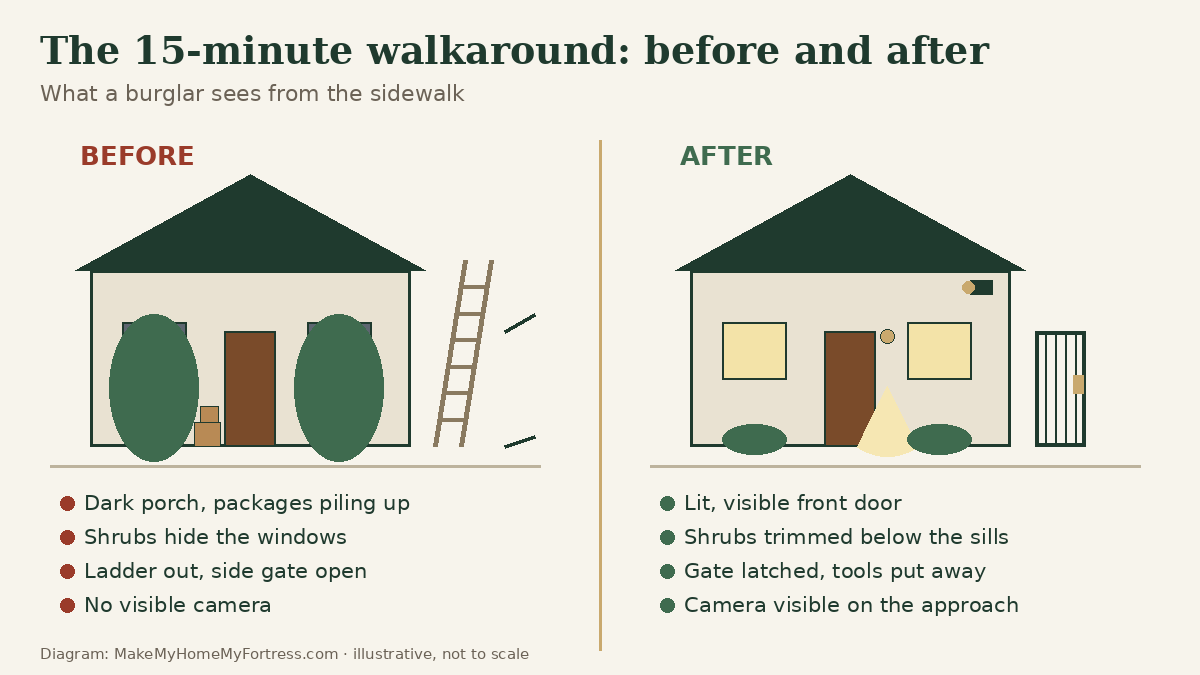
You can't make a house impossible to break into. What you can do is make it a worse choice than the houses around it. The best research we have on how burglars pick targets says they're weighing three things: is anyone home, can I get in without being seen, and can I get out fast. This 15-minute walkaround looks at your house the way they do, from the street in, and gives you a simple score to compare against the two houses next door.

How burglars actually choose a house
A 2012 UNC Charlotte survey of 422 incarcerated burglars found that most of them considered three groups of things when picking a target: other people nearby (neighbors, traffic, people walking by, someone inside), a lack of escape routes, and signs of security like alarm signs, alarms, dogs inside and outdoor cameras. About 60% said an alarm would make them look for a different target altogether, and about 83% said they'd try to find out whether an alarm was present before attempting a break-in.
The neighborhood matters too. A study in the Journal of Quantitative Criminology that combined 679 burglaries with data on about 138,000 homes in Ghent, Belgium found burglars favored detached houses in lower-density neighborhoods, areas they had recently hit, and places near where they lived. You can't change your street, but you can change how your house compares to the others on it.
Closer to home: ABC7 reported on March 13, 2026 that LAPD burglary and break-in counts were down year-to-date citywide (1,437 vs. just over 2,100 for the same stretch of 2025), while police said organized crews were still targeting higher-end homes near freeways. LAPD Captain Mike Bland told ABC7, "If I'm a suspect, I want to avoid detection. I want to operate in shadows." He also urged homeowners to put away screwdrivers, shovels and other tools a burglar could use to get in.
Keep those three questions in mind: Is anyone home? Can I get in unseen? Can I get out fast? Every step below takes away an easy "yes."
The 15-minute walkaround (do it at dusk)
Do this once in daylight if you want, but the evening walk is the one that counts, because it shows you what your lighting really does. Bring your phone to take photos and jot notes. Walk the route a stranger would take.
- Minutes 0–3: Across the street. Stand on the far sidewalk and look at your house, then at the houses on either side. Which one looks most obviously empty? Look for a dark porch, a full mailbox, packages, trash bins left at the curb, or blinds that show the same gap all day. Can you see valuables or a TV through the front window?
- Minutes 3–6: The front approach. Walk up to the door the way a delivery driver would. Is the door lit? Could someone stand there without a neighbor seeing them? Is there a visible doorbell camera or camera? Do shrubs or a tall hedge block the view from the street?
- Minutes 6–9: The side yard and gate. This is the path most people forget. Can you reach the backyard without opening anything? Is the side gate latched and locked? Is there a trash can, ladder or patio chair someone could use to climb a fence or reach a window?
- Minutes 9–12: The back of the house. Stand where the neighbors can't see you. That's where a burglar wants to work. Check the slider, back door and ground-floor windows. Are tools, shovels or a pry-worthy piece of rebar lying around? Is there a motion light covering this side?
- Minutes 12–15: The garage and the exit. Is the garage door down, and is the side door to the garage locked? Is the remote visible in a car parked outside? Then picture leaving in a hurry: is there a back alley, an easy fence or a quick route to a main road? You can't remove an escape route, but you can light it and put a camera on it.
Score it, then compare with your neighbors
Give yourself one point for every "yes." Then do a quick, honest guess for the houses on either side from what you can see from the sidewalk. The goal isn't to push trouble next door. It's to stop being the easiest option on the street, and the best way to do that long-term is to share this list with those same neighbors.
- Front door is lit after dark (fixture or motion light).
- No shrubs taller than about waist height under front windows.
- No packages, flyers or piled-up mail visible.
- Side gate is latched and locked.
- No ladders, tools or climbable items in the side or back yard.
- Back of the house has a motion light.
- A camera or doorbell camera is visible from the approach.
- Alarm sign or sticker is posted (only if you have an alarm or plan to).
- Garage door is closed and its side door is locked.
- No valuables visible through windows from the street.
Eight or more is a good place to be. Below six, start with the cheap fixes below this week.
Cheap fixes you can do this weekend
- Light the approach. A motion light at the front door and one covering the back or side yard. Our guide on where to put motion lights covers aim and placement.
- Trim the cover. Cut shrubs under windows down so someone standing there is visible from the street. Thorny plants under windows help too, as the ABC7 report noted. See Tactical Foliage 101.
- Lock the side gate with a padlock or keyed latch, and put away ladders, tools and anything stackable. If you want the gate to close and latch itself, see self-locking doors and gates.
- Make it look occupied. Put lamps on timers, ask a neighbor to grab packages and roll in bins, and hold mail when you travel. Our vacation checklist has the full routine.
- Upgrade the strike plate. Long screws into the stud are one of the cheapest real hardening steps. A high-security strike like the Prime-Line Defender U 9480 comes with long screws. Here's why it matters.
- Block the slider with a bar such as the Master Lock 265 security bar, which also shows from outside that the door won't slide.
Bigger upgrades worth planning
- Cameras that cover the side and back. In the ABC7 report, an installer suggested mounting cameras about 8 to 10 feet up and hiding exposed wires, since a visible cord can just be cut. A battery or hardwired spotlight camera like the Ring Spotlight Cam Plus adds light and a visible camera in one unit.
- An alarm system with signs. In the UNC Charlotte survey, alarms were among the strongest deterrents burglars described. A sign alone is a weaker cue, so pair it with a real system when you can.
- A smart deadbolt with auto-lock, such as the Schlage Encode, so a door left unlocked locks itself. Compare options in smart locks vs. deadbolts.
- Door and window hardening: see door reinforcement and window security film and locks.
What the walkaround won't catch
This is an outside-in look at how inviting your house appears. It doesn't test your locks, windows or garage hardware up close, and it doesn't cover what happens inside. For that, follow up with our 30-minute home security audit. And for the research behind each cue, see why burglars avoid some homes. None of this makes a home burglar-proof. It lowers the odds and buys time, which is what most layers of security do. We haven't measured these steps ourselves; they come from the sources linked above and standard crime-prevention guidance.
If you see someone casing a home or trying doors, call 911. In Los Angeles, LAPD's crime prevention staff can also point you to local resources and Neighborhood Watch.
Printable walkaround checklist
Print this or screenshot it, and redo the walk every season (or after the clocks change).
- ☐ Across the street: house doesn't look empty (porch light, no packages, bins in, mail cleared)
- ☐ No valuables visible through front windows
- ☐ Front door lit and visible from the street
- ☐ Shrubs under windows trimmed below waist height
- ☐ Side gate latched and locked
- ☐ Ladders, tools, bins and patio furniture stored or chained
- ☐ Motion light covering the back and side yard
- ☐ Camera visible on the approach; wires hidden
- ☐ Slider barred; back door strike plate uses long screws
- ☐ Garage door down, side door locked, remote not left in a car outside
- ☐ Lamps on timers for evenings out
- ☐ Shared this list with the neighbors on each side
FAQ
How do burglars choose which house to break into?
Burglar surveys and crime studies point to three questions: does the house look empty, can they get in without being seen, and is there a fast way out. In a 2012 UNC Charlotte survey of 422 burglars, most said people nearby, a lack of escape routes and visible security like alarms, cameras and dogs shaped their choice.
Do alarm signs and stickers deter burglars?
Signs help a little, but a real alarm matters more. About 60% of burglars in the UNC Charlotte survey said an alarm would make them pick another target, and about 83% said they try to find out whether an alarm is present first. Pair a sign with a working system when you can.
What is the cheapest way to make my house less of a target?
Light the front door and back yard, trim shrubs under windows, lock the side gate, put away ladders and tools, and keep packages and mail from piling up. Long screws in the door strike plate and a bar in the slider are inexpensive hardening steps.
How often should I do a home security walkaround?
Once a season is a good rhythm, plus after you change landscaping, lighting or cameras. Do it at dusk so you see what your lights really cover.
Sources
- Kuhns, Blevins & Lee, UNC Charlotte: Understanding Decisions to Burglarize from the Offender's Perspective (Dec. 2012), 422 incarcerated burglars; ~60% alarm → seek other target; ~83% check for alarm (accessed/as of 2012-12-01)
- Journal of Quantitative Criminology: "Location, Location, Location": neighborhood and house attributes in burglars' target selection (679 burglaries, ~138,000 residences, Ghent) (published 2019; accessed 2026-11-15) (accessed/as of 2026-11-15)
- ABC7 Los Angeles (Kevin Ozebek): With gangs behind many SoCal break-ins, experts explain how to protect your home, Mar. 13, 2026 (LAPD YTD 1,437 vs ~2,100; Capt. Mike Bland quotes; 8–10 ft camera height) (accessed/as of 2026-03-13)
Download it and join the Fortress Newsletter.
This is general information, not professional security, legal or safety advice. Follow local codes and official guidance (ready.gov, CAL FIRE). See our disclosures.