How a Door Kick-In Actually Fails (and the 4 Fixes That Stop It)
Disclosure: This article may contain affiliate links. If you click one and make a purchase, MakeMyHomeMyFortress.com may earn a commission at no extra cost to you. As an Amazon Associate we earn from qualifying purchases.
Quick answer: When a door is kicked in, it's usually the frame that fails, not the door or the deadbolt: short strike-plate screws tear out of the thin jamb and the jamb splits along the lock side. The fix, in order of impact, is a heavy-duty strike plate with 3-inch screws into the wall stud, a full-length jamb reinforcement kit for doors you're most worried about, long screws in the hinges and a metal wrap on the door edge. None of it makes a door kick-proof, and glass next to the lock bypasses all of it.
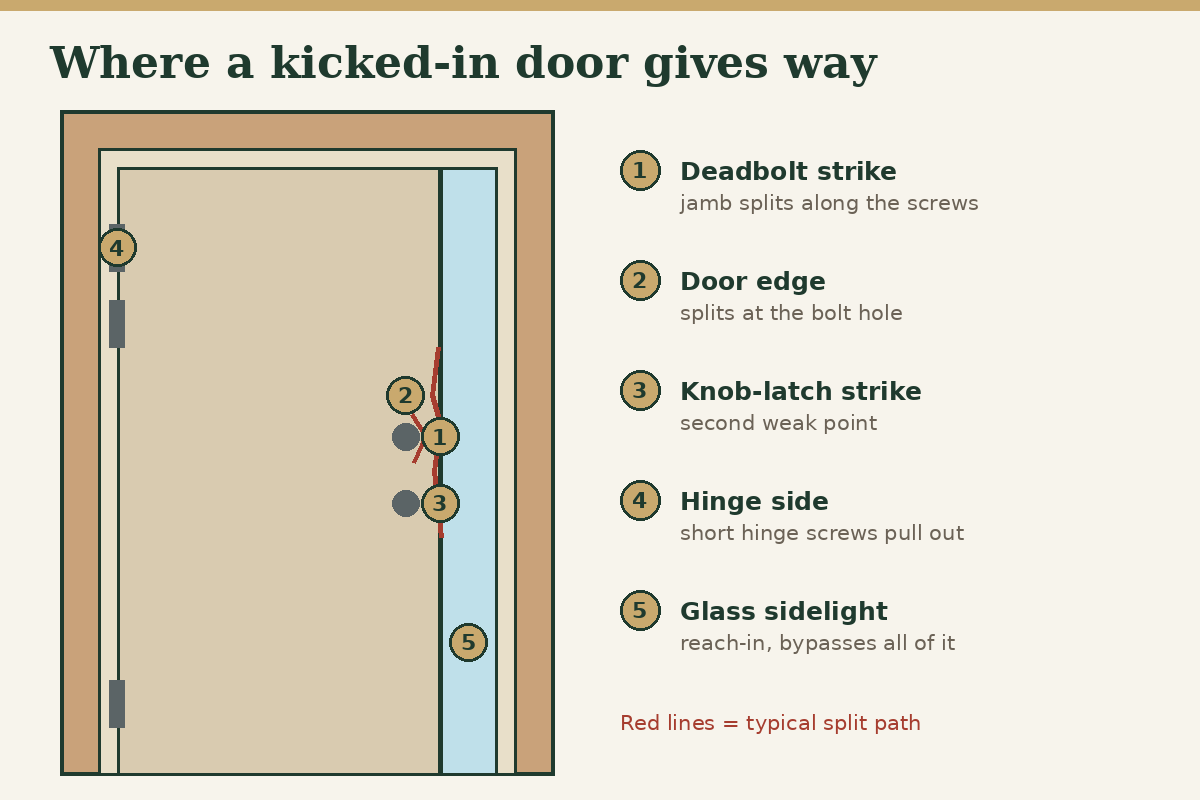
When a door gets kicked in, the door itself usually survives. What breaks is the thin strip of wood that holds the lock. If you understand that failure path, you know exactly where your money should go, and it's mostly not into a fancier deadbolt. Here's how a kick-in actually fails, a 10-minute check you can do on your own door tonight, and the four fixes in order of impact.

Where a door breaks when it's kicked in
The Seattle Police Department's crime prevention bulletin puts it plainly: kicking is the most common way to force a door with a wooden jamb, the frame usually splinters, and "the weakest point is almost always the strike plate." Here's the sequence, in the order things usually give way:
- The strike plate screws let go. Factory strike plates are commonly held by short screws that only reach the jamb, the thin board the door closes against. They never touch the framing behind it. The bolt is strong; what it's locked into isn't.
- The jamb splits along the grain. The kick drives the bolt sideways against the strike. The jamb splits lengthwise through the screw holes and the mortise cut for the bolt, often in one long piece, and the door swings open with the bolt still extended.
- The door edge can split too. On a weaker door, the wood around the bolt hole on the door's own edge cracks out. Even a perfect strike can't help if the bolt pulls out of the door.
- The hinge side is the backup failure. Hinges held by short screws can tear out of the jamb, especially once the lock side is reinforced. On doors that swing outward, exposed hinge pins are a separate weak point.
- Glass skips all of it. A glass sidelight or a window in the door lets someone break the glass and reach the thumb turn. In a 2024 West LA community alert, LAPD said one burglary crew would "smash or cut out a glass partition of the door" to get in. No jamb kit fixes that.
The 10-minute check: how weak is your door?
Grab a screwdriver and look at each exterior door, including the one from the garage into the house.
- Pull one strike plate screw. If it's around an inch long or shorter, it's only in the jamb.
- Look at the strike. A small plate with two screws is the builder-grade version. A longer plate with four or more screw holes, ideally with a box behind the bolt hole, is the upgrade.
- Check the deadbolt throw. Seattle PD's bulletin says the bolt should extend at least 1 inch. Lock the door while it's open and measure.
- Pull one hinge screw from the jamb side. Short again? That's your hinge-side weak spot.
- Tap the door. A hollow, drum-like sound means a hollow-core door. Reinforcing the frame around a hollow door has limited value; a solid-core or steel door is the bigger upgrade.
- Look for glass within arm's reach of the lock.
Fix 1: A high-security strike plate with 3-inch screws into the stud
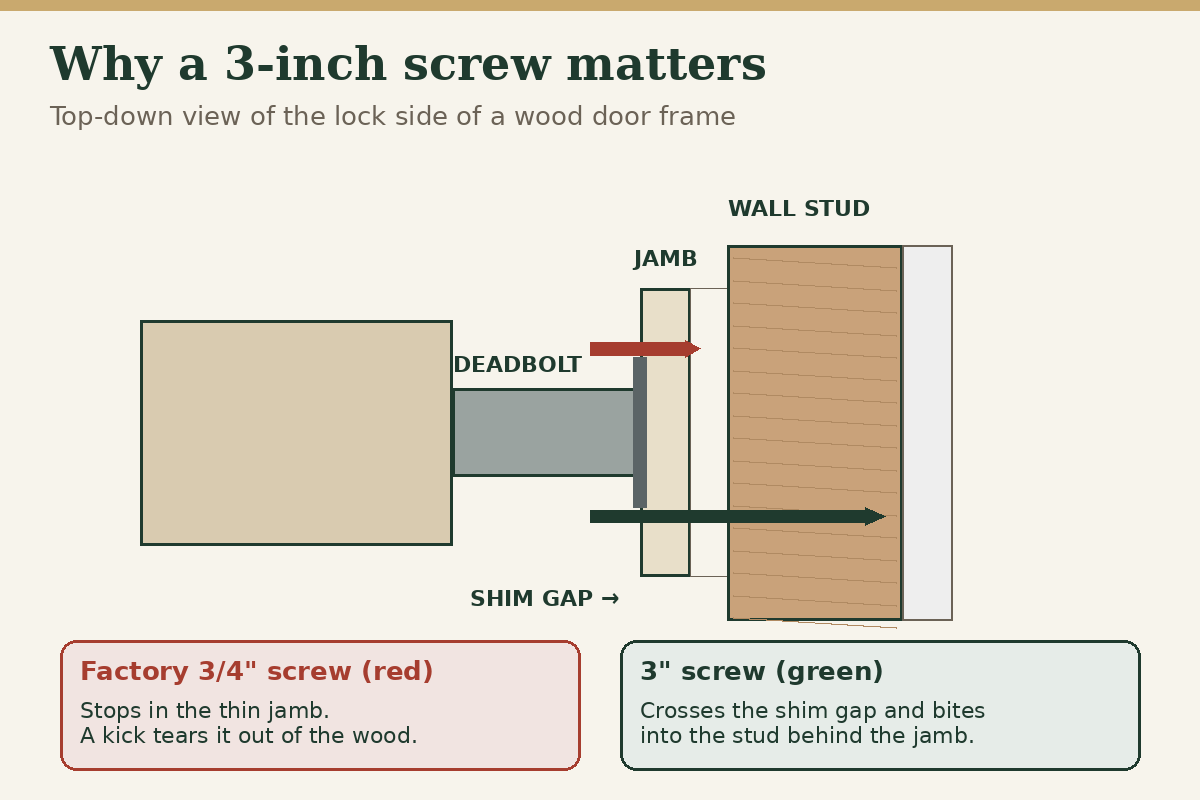
This is the highest-impact, lowest-cost fix. Seattle PD recommends removing the short screws in the strike plates and hinges and replacing them with 3- to 4-inch wood screws so the frame is anchored to the wall stud, and upgrading to a four-screw, heavy-duty strike. Its bulletin says this one step "will deter or prevent most through-the-door forced entries."
A steel plate like the Prime-Line Defender Security U 9480 strike with exterior-rated screws such as SPAX #10 x 3-inch wood screws covers it. Do both the deadbolt strike and the knob-latch strike.
The shim gap matters. There's usually a small gap between the jamb and the stud, filled with shims at a few points. A long screw driven hard where there's no shim pulls the jamb toward the stud and can bow it, so the bolt binds or the door won't latch. Drive the screws snug, not cranked, and check that the bolt still throws smoothly. If the jamb moves, back the screw off and slip a shim into the gap behind it. Our door reinforcement guide has the full step-by-step install.
Fix 2: A full-length jamb reinforcement kit (are they worth it?)
A jamb kit is a long steel channel that covers the lock side of the jamb, sometimes several feet of it, screwed through to the framing. Instead of one strike holding the force, the whole length of the jamb shares it, so the split in step 2 has nowhere to start. A kit like Door Armor MAX also includes hinge shields and a door-edge wrap.
Are they worth it? They make the most sense when:
- your jamb has already been split or repaired,
- it's the door you're most worried about (out-of-sight back or side door, garage entry door), or
- you want one kit that handles the strike, hinges and door edge at once.
If your door is solid, the jamb is sound and you've done Fix 1, the jump to a full kit is smaller. We haven't installed one ourselves; read the manufacturer's instructions, since most require removing the strike, some trim work and a bit of chiseling.
Fix 3: Reinforce the hinge side
Once the lock side holds, the hinges take the load. Seattle PD says to use at least one long screw in each door hinge. In practice, replace one jamb-side screw per hinge (the one closest to the door stop) with a 3-inch screw into the stud, snug and checked for binding. If your door swings outward with exposed hinge pins, add non-removable pins or hinge security studs so pulling the pins doesn't free the door.
Fix 4: Wrap the door edge around the lock
A door-edge wrap (sometimes called a door reinforcer) is a U-shaped metal plate that wraps the door's edge around the deadbolt and knob holes. It addresses failure point 3, the door splitting at the bolt hole. It's most useful on wood doors and doors where the lock bore is close to the edge. Many jamb kits include one.
Honest limits
- Nothing here makes a door "kick-proof." Reinforcement buys time and noise. The goal is that a quick kick fails and the person moves on, or that you, a neighbor or a camera notices.
- Glass beats hardware. Sidelights and door glass need their own fix: security film, a different door, or keeping keys and openers out of reach. Seattle PD also mentions double-cylinder deadbolts near glass but warns about fire-exit risk and local code limits, so check your code before going that route.
- Pry tools are a different attack. The same bulletin notes a rise in pry attacks and suggests 3- to 4-inch strike screws, a deadbolt and a latch guard.
- Renters: swapping screws and a strike is usually minor, but ask your landlord before changing hardware, and keep the original parts.
- When you're home, a bar like the Master Lock 265 door and patio security bar adds a brace you can set at night. A good deadbolt still matters; see smart locks vs. deadbolts.
Why now
Clocks fell back on November 1, so in Los Angeles it's dark before most people get home. It's a good weekend to pull a screw out of each exterior door and see what you've got. Most of Fix 1 and Fix 3 is a screwdriver, a drill and an hour.
Printable checklist: kick-in check for every exterior door
- ☐ Strike plate screws are 3 inches or longer and reach the stud (deadbolt and knob latch)
- ☐ Strike is a heavy-duty, four-screw (or longer) plate
- ☐ Deadbolt throws at least 1 inch and locks smoothly after the upgrade
- ☐ At least one long screw in each hinge, into the stud
- ☐ Outswing doors: non-removable pins or hinge studs
- ☐ Door is solid-core or steel (not hollow)
- ☐ Door edge wrapped around the lock on wood doors
- ☐ Glass within reach of the lock addressed
- ☐ Garage-to-house door gets the same treatment
Then run the rest of the house through our 30-minute home security audit.
FAQ
Where does a door break when it's kicked in?
Usually at the frame on the lock side. Short strike-plate screws pull out of the thin jamb, and the jamb splits along the screws and the bolt mortise. The door edge around the bolt hole and the hinge side are the next weak points.
Are door jamb reinforcement kits worth it?
They're most worth it on a jamb that's already been split or repaired, on out-of-sight back, side or garage-entry doors, or when you want the strike, hinges and door edge covered at once. On a solid door with a sound jamb, a heavy-duty strike with 3-inch screws gets you much of the benefit for less.
Do 3-inch screws really make a difference?
Yes. Factory strike screws usually stop in the jamb, while 3-inch screws reach the wall stud behind it. Seattle Police recommend 3- to 4-inch screws in strike plates and at least one long screw in each hinge.
Can a long screw damage my door frame?
It can bow the jamb if you overtighten where there's no shim behind it, which makes the bolt bind. Drive the screws snug, check that the deadbolt still throws smoothly, and add a shim behind the jamb if it moves.
Will reinforcement make my door kick-proof?
No. It makes a kick-in slower and noisier, which is the goal. Glass within reach of the lock, a hollow-core door or pry tools can still get past it, so treat reinforcement as one layer.
Sources
- Seattle Police Department Crime Prevention Bulletin: Home Security: Door Security (checked 2026-11-13) (accessed/as of 2026-11-13)
- ABC7 Los Angeles: LAPD West LA community alert (glass partition entry), Aug. 29, 2024 (accessed/as of 2024-08-29)
- ABC7: Daylight saving time 2026 ends Nov. 1, 2026 (accessed/as of 2026-10-01)
Download it and join the Fortress Newsletter.
This is general information, not professional security, legal or safety advice. Follow local codes and official guidance (ready.gov, CAL FIRE). See our disclosures.