Motion-Sensor Lights: Where to Put Them So Intruders Actually Get Noticed
Disclosure: This article may contain affiliate links. If you click one and make a purchase, MakeMyHomeMyFortress.com may earn a commission at no extra cost to you. As an Amazon Associate we earn from qualifying purchases.
Quick answer: Motion-sensor lights help most when they make someone visible to people who can react: they light the spots an intruder has to cross, and they work best paired with a camera, neighbors' sightlines and locked doors. A large randomized trial in New York found added outdoor lighting cut serious nighttime outdoor crime by 36%, but lights alone won't stop a determined person. Put them at every entry door, the garage and driveway, side gates, side yards and the back slider, aimed down at your own ground.
It's dark before 5 PM in Los Angeles this month (sunset in the Valley was 4:57 PM on November 5), so the hours when your yard is dark and you're home, or away, just got longer. Motion lights are one of the cheapest upgrades you can make. They're also one of the easiest to install badly: in the wrong spot, aimed at the street or tuned so the cat sets them off all night. Here's what the evidence says, where to put them and how to set them up.

Do motion lights actually deter burglars?
Lighting has some of the better evidence in home security. In a randomized controlled trial run with the NYPD and the New York City Housing Authority, the University of Chicago Crime Lab put new outdoor lights at roughly half of nearly 40 public housing developments and compared them with the rest. The developments that got lights saw a 36% reduction in serious "index" crimes committed outdoors at night.
Two honest caveats. That study looked at street-style lighting across housing developments, not a single porch light on a house. And light only helps when it makes someone seen. A motion light that clicks on in a fenced back yard nobody can see into mostly tells an intruder where to step. The practical rule: put light where it creates visibility. That means lighting the spot for neighbors and passersby, for your camera, or for you through a window.
Step 1: Light the five spots that matter first
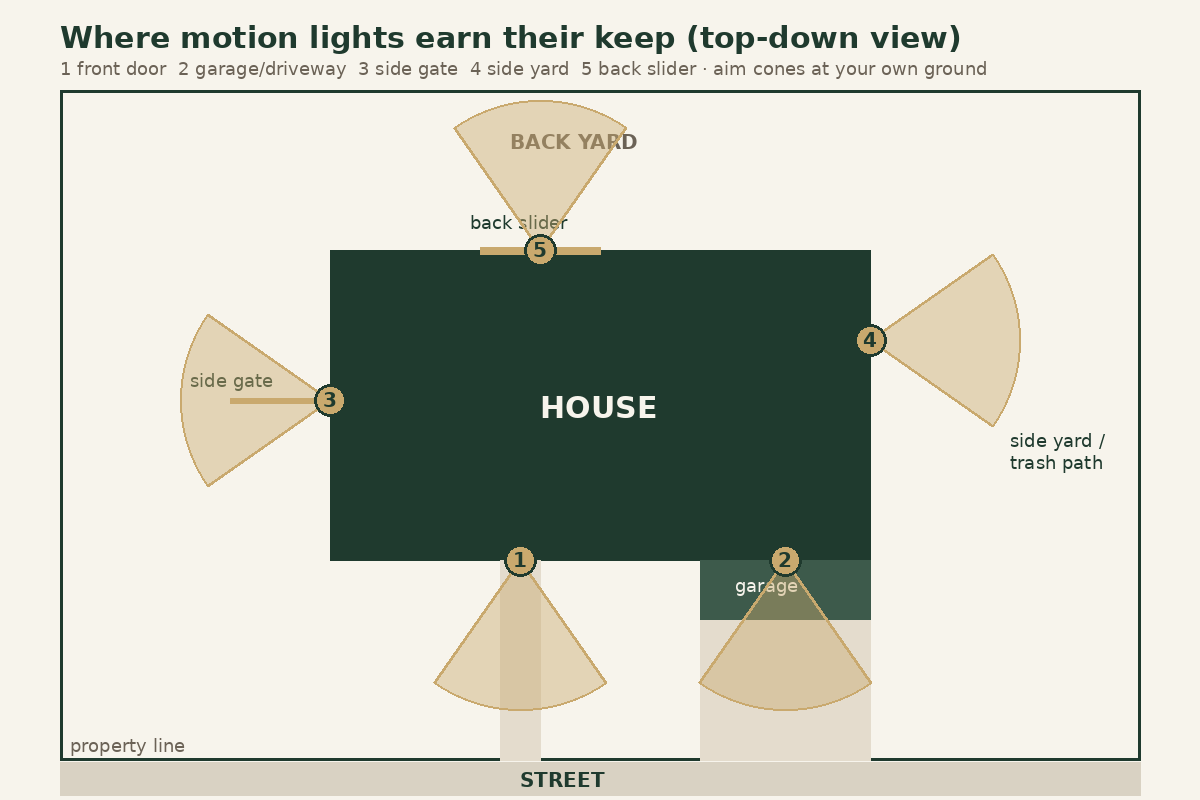
Walk your property at night with the lights off and stand where someone would have to stand to get in. Those are your spots. On most homes, they are:
- Front door and porch. Mount the light so it shows a face at the door, not just the doormat. Pair it with a doorbell camera if you have one.
- Garage door and driveway. Cover the car, the garage door and the walk from the driveway to the house. This is also the light you'll be grateful for carrying groceries in at 6 PM.
- Side gate. The side gate is the quiet route to the back of the house. Light both sides if you can, and make sure the gate itself closes and latches on its own.
- Side yards and the trash path. Narrow side yards are dark, out of view and lined with things to stand on. One light that covers the whole run beats two that leave a dark middle.
- Back slider and back door. Rear doors are out of the street's view, so pair this light with a camera or a window you actually look out of. Then secure the slider itself.
Then check ground-floor windows hidden by shrubs. Often the better fix there is trimming the shrub, not adding a light. Our tactical foliage guide covers what to cut and what to plant.
Step 2: Mount, aim and tune them so they work
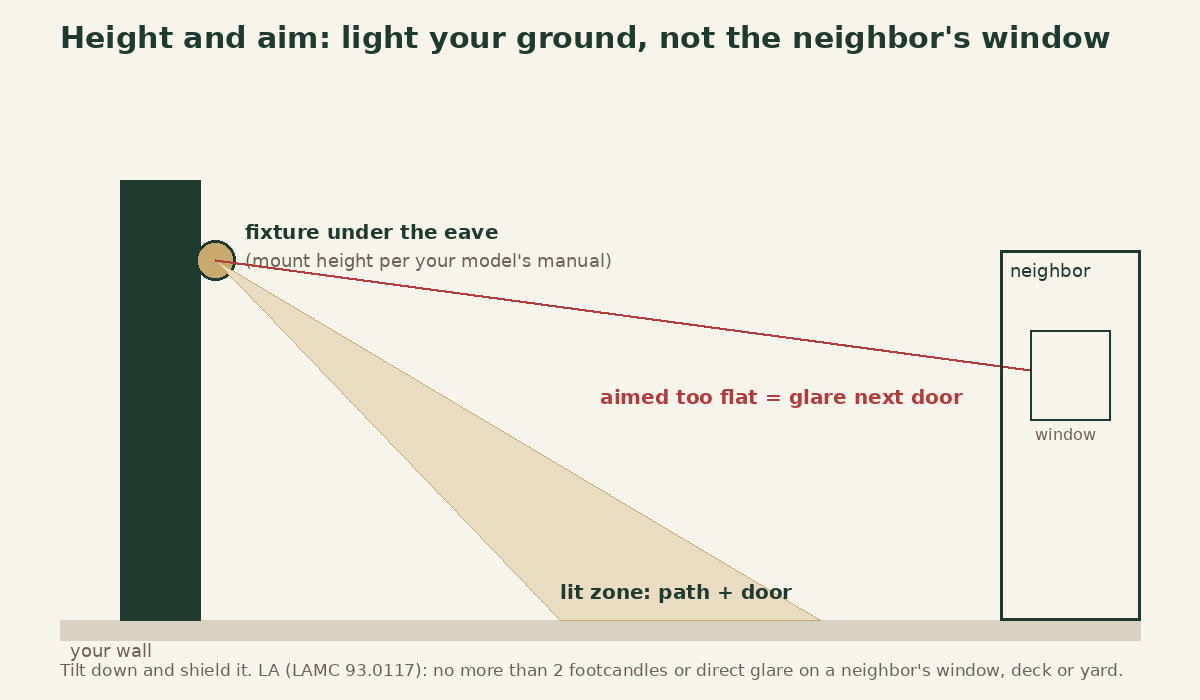
- Height. Follow the mounting height in your model's manual. Too low and the light is easy to reach or unscrew; too high and the sensor may miss people at the edges of its range.
- Aim the light down. Tilt the lamp head toward the ground you want lit. A beam aimed flat goes into your neighbor's bedroom and blinds anyone looking toward your house, including your own camera.
- Aim the sensor across the path, not straight down it. Most motion lights use passive infrared (PIR) sensors, which detect warm bodies moving across their field. They generally pick up someone crossing the zone faster than someone walking straight at them.
- Tune out false triggers. Lower the sensitivity (often a dial labeled SENS) a step at a time, narrow the sensor's view away from the sidewalk and street, and keep it from "seeing" swaying branches, warm vents and car headlights. For pets, angle the sensor slightly upward or mask the lower edge of the lens with the shields some models include. Test at night, after each change.
- Set the on-time short. A light that switches on and stays on for a short time draws attention. One that stays on for a long time starts to look like a porch light. Pick the shortest setting that still gets you from the car to the door.
Step 3: Pick solar, hardwired or smart
- Solar. No wiring, so they're easy for renters and side yards with no outlet. The trade-offs: the panel needs real sun, and short winter days and shade mean less run time. Check them in December, not just in July.
- Hardwired. These replace an existing exterior fixture, are the brightest and most reliable, and never need charging. Swapping a fixture on an existing box is a common DIY job. If you're adding a new circuit or box, check your city's permit rules or hire a licensed electrician.
- Smart lights and floodlight cameras. These can send an alert, record a clip and, in some systems, turn on other lights. A camera with a built-in light, such as the Ring Spotlight Cam Plus (Battery), covers lighting and recording in one mount. See our outdoor camera guide for options. In Apple Home, a motion sensor in the yard can turn on every exterior light at once after a set hour.
We haven't installed any of these ourselves. Read the spec sheet for brightness (lumens), detection range and weather rating before you buy.
Los Angeles: keep your light on your property
Bright security lights are the classic neighbor complaint, and in the City of Los Angeles they're regulated. LAMC Section 93.0117 says an exterior light may not put more than two footcandles of light, or direct glare, on a neighbor's windows or sliding doors, an elevated porch, deck or balcony, or yard areas they use. Exceptions include frosted bulbs of 800 lumens or less and brighter lights whose source can't be seen from the other residential property. If the city sends written notice, the owner has to bring an existing light into compliance. Other cities and LA County have their own rules, so check yours. Practically: shield it, aim it down, and walk next door at night to see what your neighbor sees.
Pair lights with the layers they need
A light is an alarm that makes no sound. It works when it gets someone noticed: by a camera, by a neighbor or by you. So pair each light with something that reacts. That could be a camera covering the same zone, a window you can see the spot from, or a neighbor who'll look when it clicks on. Then make sure the door it lights is actually locked and reinforced. Our guide to why burglars skip some homes covers the other signals that make a house a harder target.
Printable motion-light checklist
- ☐ Walked the property after dark with all lights off and marked the dark approach routes
- ☐ Front door lit so a face is visible, not just the mat
- ☐ Garage door and driveway covered
- ☐ Side gate lit (both sides if possible) and self-latching
- ☐ Side yards covered with no dark middle
- ☐ Back slider or back door lit and visible from a camera or window
- ☐ Every lamp head tilted down; nothing shining into a neighbor's window
- ☐ Sensitivity, view and on-time tuned and tested at night (pets, street, branches)
- ☐ Solar panels checked for winter sun and shade
- ☐ Lights paired with a camera, a window or a neighbor's view
- ☐ Re-check twice a year (spring and fall time changes)
For the rest of the house, run our 30-minute home security audit.
FAQ
Do motion sensor lights deter burglars?
They help when they make someone visible to people who can react. A randomized trial in New York City public housing found added outdoor lighting cut serious nighttime outdoor crime by 36%. A light nobody can see does much less, so pair lights with cameras, neighbors' sightlines and locked doors.
Where should motion sensor lights be placed?
Start with the spots someone must cross to get in: the front door, the garage and driveway, side gates, side yards and the back slider or back door. Aim each light down at your own ground and point the sensor across the path.
How do I stop my motion light from turning on all night?
Lower the sensitivity a step at a time, narrow the sensor's view away from the street, trees and vents, angle it slightly up or mask the lower lens edge for pets, and shorten the on-time. Test at night after each change.
Are there rules about security lights shining on neighbors in Los Angeles?
Yes. In the City of Los Angeles, LAMC Section 93.0117 limits exterior lights to two footcandles, and no direct glare, on a neighbor's windows, decks or yard areas, with exceptions such as frosted bulbs of 800 lumens or less. Other cities and LA County have their own rules.
Solar or hardwired motion lights?
Hardwired lights are brighter and never need charging. Solar is easier for renters and spots with no wiring, but short winter days and shade reduce run time, so check them in December.
Sources
- University of Chicago Crime Lab, Reducing Crime Through Environmental Design (NYC street-lighting randomized trial; paper Jan 2021) (accessed/as of 2026-11-12)
- Los Angeles Municipal Code Sec. 93.0117, Outdoor Lighting Affecting Residential Property (Ord. 184,692; text as of 2026-09-23) (accessed/as of 2026-11-12)
- Sunrise and sunset times, Encino, CA (November 5, 2026) (accessed/as of 2026-11-12)
Download it and join the Fortress Newsletter.
This is general information, not professional security, legal or safety advice. Follow local codes and official guidance (ready.gov, CAL FIRE). See our disclosures.