Security Film on Sliding Glass Doors: What It Really Does (4 vs 8 vs 12 Mil)
Disclosure: This article may contain affiliate links. If you click one and make a purchase, MakeMyHomeMyFortress.com may earn a commission at no extra cost to you. As an Amazon Associate we earn from qualifying purchases.
Quick answer: Yes, but only as a delay layer: security film holds broken glass together so a smash-and-grab takes longer and makes more noise, and it doesn't make the glass unbreakable or stop a slider from being lifted or jimmied. For most home sliders, an 8 mil film is the practical choice, and because slider glass is usually tempered, the film should be anchored to the frame or the whole sheet can fall out once it breaks. Pair it with a track bar and a pin lock, which stop the attacks film can't.
Sliding glass doors are big, usually out of sight from the street, and often the easiest glass on the house to reach. So it's fair to ask whether a $70 roll of security film actually changes anything. It does, but less than the packaging suggests, and on a slider the glass type and how the film is installed matter more than the number on the box. Here's what film really does, how to pick 4, 8 or 12 mil, and how to pair it with the two cheap locks that cover what film can't.

What security film actually does (and doesn't)
Security film is clear polyester with a very aggressive adhesive, applied to the inside face of the glass. According to the International Window Film Association's 2026 Safety & Security Education Guide, when the glass breaks the film stretches and absorbs some of the energy, so the broken glass tends to stay together in the frame instead of falling out.
For a door, that means a burglar who smashes the glass doesn't get an instant opening. They have to keep hitting, tearing and pushing a sagging sheet of broken glass, which takes time and makes noise. That's the whole value: time and noise, the two things that make most burglars give up or get noticed.
What film does not do:
- It doesn't make glass unbreakable. The glass still shatters. Film only changes what happens next.
- It isn't bullet-resistant. The IWFA guide states plainly that it makes no claim that any film and glass combination is bullet resistant or "bullet-proof."
- It doesn't fix the lock. Most sliders are opened by lifting the panel off its track or defeating the thin latch, with no glass broken at all. Film does nothing about that. See how to secure a sliding glass door for those fixes.
The best way to think about it: film is a delay layer on top of locks, light and an alarm, not a replacement for any of them.
Why sliding doors are different: tempered glass
Most sliding glass doors use tempered (safety) glass, because it breaks into small, blunt pieces instead of long, sharp shards. That's great for anyone who falls into the door. It's a problem for film. The IWFA guide notes that the standard "daylight" install, where the film stops just short of the frame, is generally enough to hold broken ordinary (annealed) glass in place, but that tempered glass needs a more robust method to keep it from falling out of the frame once it crumbles.
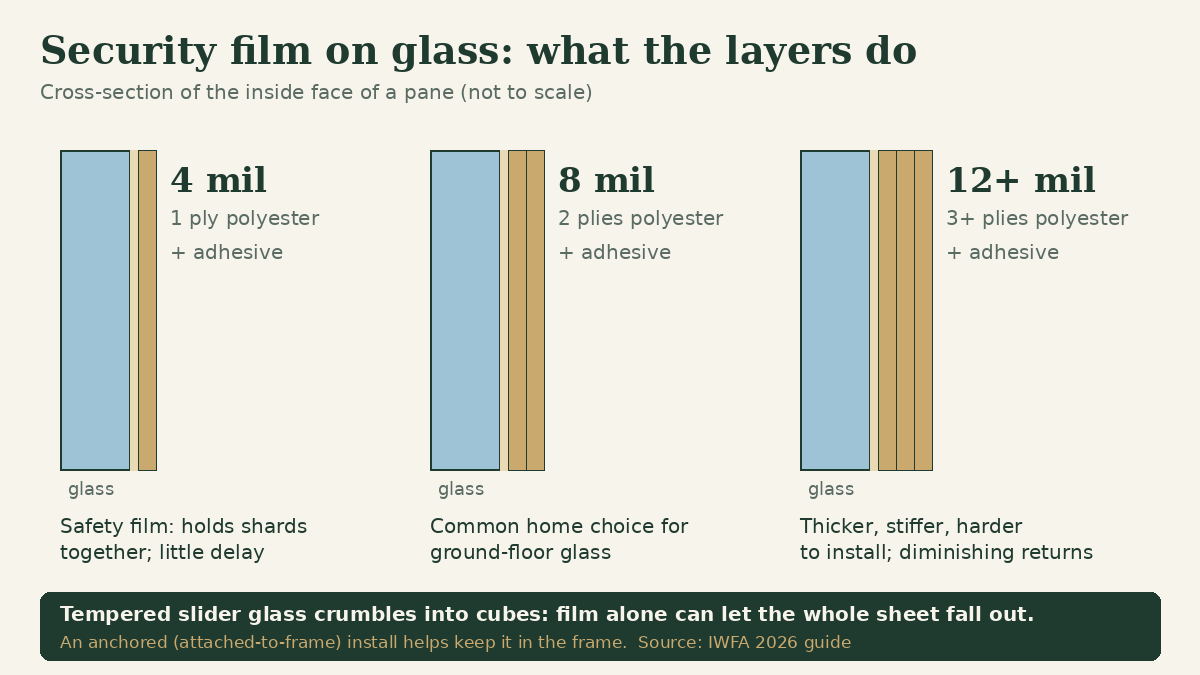
In plain terms: on a tempered slider, film alone can hold the cubes together while the whole sheet folds and drops out of the frame like a wet blanket. To get the real benefit you want the film attached to the frame.
How to tell if your slider is tempered: look in each corner of each panel for a small etched or sand-blasted label (a "bug") mentioning tempered or safety glazing. Most sliders have one. If you can't find it, assume tempered.
4 vs 8 vs 12 mil: which thickness to buy
A mil is one-thousandth of an inch. The IWFA guide says safety films range from 4 mils up to about 15 mils, and that thicker films are usually made by laminating layers together (two 4-mil plies make an 8-mil film, three make a 12). More plies generally absorb impact more evenly before the film reaches its burst point.
- 4 mil: a safety film. It's good at holding shards together after an accident. Don't expect much delay against a deliberate attack.
- 8 mil: the practical sweet spot for a home slider or ground-floor window. It's still manageable for a careful DIY install. The BDF S8MC we link, for example, is listed by its maker as 8 mil, passing ANSI Z97.1 Class B and CPSC Category 1 safety-glazing tests, with up to 99% UV rejection, and the maker itself describes it as "an added protective layer rather than making the window break-in, impact, or storm proof" (BDF product page, checked 11/16/2026).
- 12 mil and up: stiffer, harder to squeegee flat and usually a pro install. Worth it for a large, hidden slider or a home that has already been hit, less so for a typical house where the anchoring matters more than the extra plies.
A note on "tested" claims: the IWFA guide explains that UL 972, the classic burglary-resisting glazing test, drops a 5-pound steel ball from 10 feet onto the same sample five times, and that UL won't issue a passing report for a film and glass combination alone; the whole glazing system including the frame has to be tested. So be skeptical of any film sold as "UL 972 certified" for your door.
Step by step: filming a slider the right way
- Check warranties first. Some window and glass makers limit their glass or seal warranty if aftermarket film is applied, and film makers' own glass-breakage coverage usually applies only to approved film and glass combinations. Read your door's warranty before you start; if it's a newer dual-pane door, ask the manufacturer.
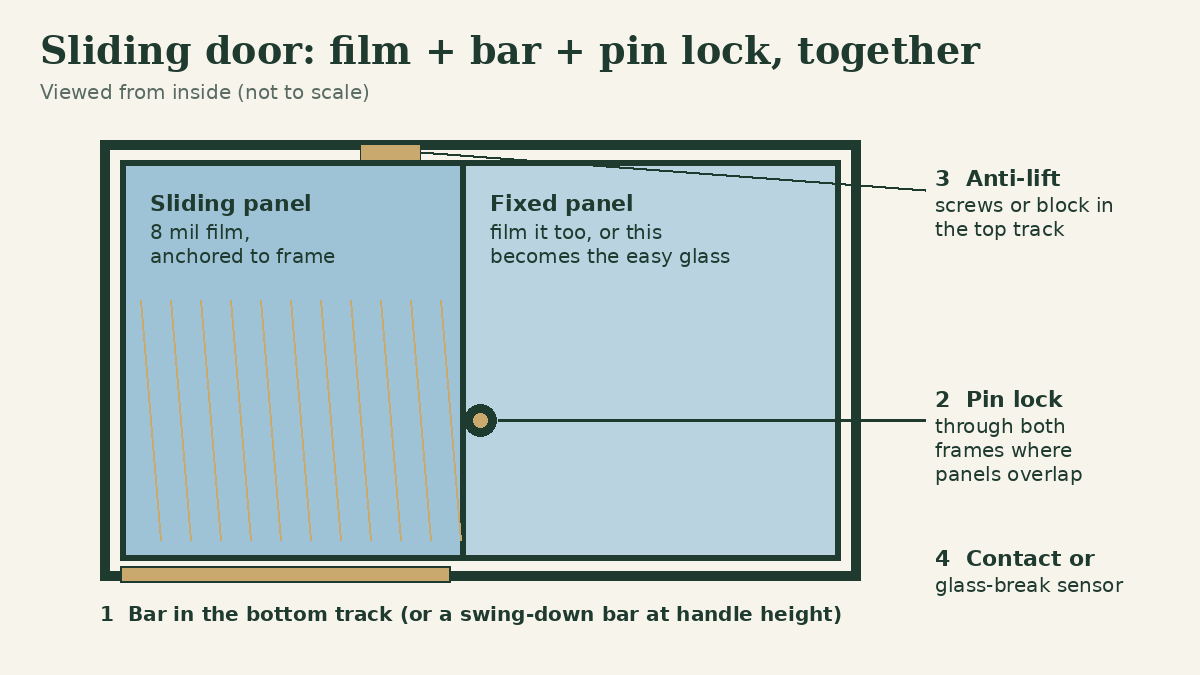
- Measure every panel. Measure the visible glass of both the sliding and the fixed panel. Film the fixed panel too, or it becomes the easy glass.
- Clean like a pro. Scrape the glass with a new razor blade and a soapy-water solution, wipe the gaskets and corners. Dust under film shows forever.
- Install out of direct sun. The maker's tips: soak the glass and the adhesive side heavily with slip solution, get a second person for anything wider than about 30 inches, and use the tape trick to peel the liner.
- Squeegee from the center out, then trim with a sharp blade about 1/16 inch from the frame.
- Let it cure. Film looks hazy or has small water pockets for days to weeks while it dries. Don't add the anchor or poke at it until it's clear.
- Anchor it to the frame. The IWFA guide describes the "wet glaze" method: a bead of structural silicone that overlaps both the film-covered glass and the frame by at least 3/16 inch. Professionals may instead use a mechanical bar-and-batten or a folding adhesive strip. If you DIY the silicone, use a clear structural-grade product, tape off neat lines and keep it off the slider's rollers and track.
- Finish with the locks below. Film without a bar and pin lock leaves the easiest attack wide open.
Thick film and anchoring are where pros earn their fee. If your slider is very large, a dual-pane unit under warranty, or you just don't want a hazy edge, get two or three local quotes that state the film model, mil, and attachment method in writing.
The full slider stack (what film can't cover)
- A bar in the track. A Master Lock 265 security bar or a dowel cut to fit stops the panel from sliding even if the latch is beaten.
- A pin lock drilled through both frames where the panels overlap. It's cheap and also stops the panel from being lifted.
- Anti-lift screws in the top track so the panel can't be lifted off the rollers.
- An alert. A contact sensor or glass-break sensor turns "slow and noisy" into "slow, noisy and someone knows."
For sliding windows on the ground floor, the Prime-Line sliding window locks clamp the track so the sash can't open past a set point. More on that in window security: film, locks and the tradeoff.
Why this matters in LA right now
Back sliders keep showing up in local burglary reports. On Oct. 26, 2026, NBC Los Angeles reported that two burglars got into a Tujunga home on Estepa Drive by smashing a glass sliding door after coming in from the back of the property, and took jewelry including two Rolex watches. That's the pattern film is designed to slow: a fast smash at the back of the house, where nobody is watching. It's also why the bar, pin lock, lighting and an alarm still matter: they cover the attacks film doesn't.
If you see someone casing homes or trying back gates, call 911. For a broader look at what makes a house a target, see the 15-minute walkaround.
Honest bottom line
On a sliding glass door, 8 mil film anchored to the frame is a reasonable, low-cost delay layer, and it adds UV protection as a side benefit. Unanchored film on tempered glass helps less than most people think. And no film makes a door burglar-proof. We haven't installed or impact-tested these products ourselves; this guide is based on the IWFA guide, the manufacturer's published specs and standard crime-prevention practice linked above.
Printable slider checklist
- ☐ Found the tempered-glass label on each panel (or assumed tempered)
- ☐ Read the door/window warranty about aftermarket film
- ☐ Measured the sliding AND fixed panel
- ☐ Film is 8 mil (or thicker for a big hidden slider)
- ☐ Installed out of direct sun, squeegeed center-out, trimmed ~1/16 inch from frame
- ☐ Let it cure until clear
- ☐ Anchored with structural silicone overlapping glass and frame 3/16 inch+ (or pro attachment)
- ☐ Security bar in the track
- ☐ Pin lock through both frames
- ☐ Anti-lift screws in the top track
- ☐ Contact or glass-break sensor; motion light on the back yard
FAQ
Does security film work on sliding glass doors?
It helps as a delay layer. Film holds broken glass together so getting through takes longer and makes more noise, but it doesn't make the glass unbreakable, and it does nothing about a slider being lifted off its track or the latch being defeated. Pair it with a track bar and a pin lock.
What mil security film should I use on windows and sliders?
For most homes, 8 mil is the practical choice for sliders and ground-floor glass. 4 mil is mainly a safety film that holds shards together, and 12 mil or thicker is stiffer, harder to install and usually a professional job.
Does security film work on tempered glass?
It can, but tempered glass breaks into small cubes, so film installed only on the glass can let the whole sheet fall out of the frame. The International Window Film Association says tempered glass needs a more robust install, such as anchoring the film to the frame with structural silicone or a mechanical attachment.
Will security film void my window warranty?
It can. Some window and glass makers limit glass or seal coverage if aftermarket film is applied, and film makers usually cover glass breakage only for approved film and glass combinations. Check your door's warranty before installing.
Is security film bulletproof?
No. Residential security film is not bullet-resistant, and the International Window Film Association makes no claim that any film and glass combination is bullet resistant.
Sources
- International Window Film Association (IWFA): Safety & Security Education Guide 2026 (film construction, 4–15 mil range, daylight vs anchored installs, tempered glass, UL 972 and EN 356, no bullet-resistance claims) (accessed/as of 2026-01)
- BDF (BuyDecorativeFilm): S8MC 8 mil clear security film product page and specs (ANSI Z97.1 Class B, CPSC Cat. 1, 99% UV, install tips), checked 2026-11-16 (accessed/as of 2026-11-16)
- NBC Los Angeles: Burglars steal jewelry from a Tujunga home after smashing a glass sliding door, Oct. 26, 2026 (accessed/as of 2026-10-26)
Download it and join the Fortress Newsletter.
This is general information, not professional security, legal or safety advice. Follow local codes and official guidance (ready.gov, CAL FIRE). See our disclosures.