Dogs and Home Security: The Bark, the Bowl and the "Beware of Dog" Sign
Disclosure: This article may contain affiliate links. If you click one and make a purchase, MakeMyHomeMyFortress.com may earn a commission at no extra cost to you. As an Amazon Associate we earn from qualifying purchases.
Quick answer: Yes, a dog helps, mostly because of the noise: in burglar surveys, a dog inside the house is one of the things offenders say they weigh and avoid, and a big, loud dog deters more than a small quiet one. A "Beware of Dog" sign or a bowl by the door is a weak cue on its own. Treat a dog as an alarm layer, not the whole plan, and still lock and reinforce doors, light the approach, and secure the pet door and side gate.
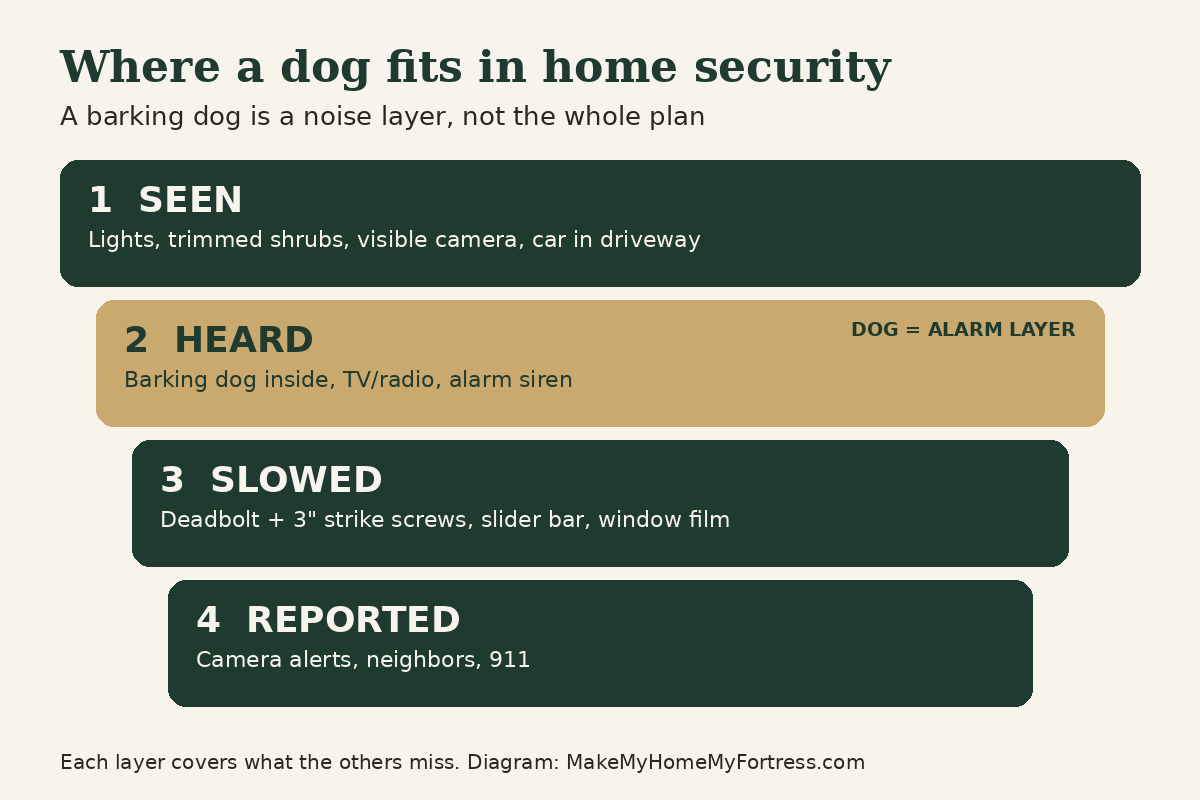
Most people with a dog already suspect it helps. The burglar surveys mostly agree, with a twist: what deters people isn't the dog's size or breed so much as the noise and the uncertainty it creates. That changes how you should use a dog in your plan, what a "Beware of Dog" sign is really worth, and what to do if you don't have a dog at all.

What burglars themselves say about dogs
Two sources come up again and again, and both are worth reading in the original rather than in the many blogs that paraphrase them.
- UNC Charlotte, 2012. Researchers Kuhns, Blevins and Lee surveyed 422 randomly selected incarcerated burglars in three states. Their final report found that most burglars considered "indicators of increased security (alarm signs, alarms, dogs inside, and outdoor cameras or other surveillance equipment)" when choosing a target, and listed dogs among the "primary deterrents," alongside people at home, noise inside, police and neighbors. Its literature review adds an honest note: earlier research found alarms are cited as more of a deterrent than dogs.
- KGW News, 2016. KGW's investigative team in Portland sent questionnaires to 86 inmates serving time for burglary in Oregon. Their summary: "If a homeowner had a big, loud dog most burglars would stay away. Smaller dogs don't seem to bother them." One inmate wrote, "Dogs are a deal breaker for me." The same respondents said they'd skip a house if they heard a TV or radio inside.
Keep the limits in mind. These are surveys of people who were caught, they ask what people say deters them, and the KGW piece is a news investigation, not a peer-reviewed study. Neither gives a reliable "dogs cut burglary by X%" number, and you should be skeptical of blogs that quote one. What they do agree on: burglars want a quiet, empty house, and a barking dog makes a house feel neither quiet nor empty.
Why the bark matters more than the bite
The UNC report frames alarms and dogs as stand-ins for occupancy: they signal that someone, or something, will make noise and draw attention. That's the useful mental model. A dog's job in your security plan is the same job a siren does:
- It's heard before entry. A dog that barks at the door or the side gate tells the person outside that the house isn't silent and that neighbors may look.
- It's unpredictable. Nobody outside knows whether the dog is friendly, how big it is, or whether someone is home with it.
- It wakes you. At night, a dog is often the first thing in the house to notice a noise, which buys you time to turn on lights and call 911.
That's why a dog inside tends to be worth more than a dog left in the backyard. A dog in the yard can be distracted, and it can't follow anyone in. A dog inside barks right at the door someone is trying to open.
The "appearance of a dog": bowl, leash and sign
If you don't have a dog, or your dog is a quiet one, you can borrow some of the effect. Be realistic about how much.
- "Beware of Dog" sign. In the UNC survey, dog and neighborhood-watch signs were considered by less than a third of burglars when they weighed a target. A sign is cheap and harmless, but on its own it's a weak signal. It works best when it's true and backed by a bark.
- Large bowl, leash or toys by the door. A visible bowl by the back door suggests a dog without saying so. It costs almost nothing. Like a sign, it's a cue, not a defense, and an observant person who watches the house for a few days will figure it out.
- Electronic watchdog (bark alarm). These plug-in units use a motion sensor and play barking that gets louder as someone gets closer. The best-known is the STI Rex Plus Electronic Watchdog, which the maker says senses through doors and walls. We haven't installed one ourselves, so treat it as an inexpensive noise layer, test where you place it, and make sure it doesn't go off every time a cat walks by. Pair it with real hardware, not instead of it.
Don't make the dog the plan
A dog is an alarm layer, not a lock. Here's what a dog doesn't do, and how to cover it:
- Dogs can be distracted, quiet down or be away. Dogs go to the groomer, the vet and the kennel when you travel. Your locks, lights and cameras need to work without them. For travel, use our vacation-proofing checklist.
- The dog door is a door. A large pet door can be an entry point for a person, or a reach-through to a lock. Use one that locks with a solid cover, and lock it at night and when you're out.
- The side gate matters twice. An unlatched gate lets a dog out and lets a person in. A self-closing, self-latching gate fixes both.
- Doors still need to hold. A dog may make someone think twice; a door that fails in one kick undoes that. See how a door kick-in actually fails for the four fixes.
- Pets and motion alarms. If you add an alarm system, check the motion sensor's pet setting in the manual, or rely on door and window contact sensors that a dog won't trip.
- Keep the dog safe. Don't train or encourage a family dog to attack. Never use a dog to confront an intruder. Get yourself, your family and the dog out, or into a locked room, and call 911.
California: you're responsible for your dog's bites
One line worth knowing if you live in California: under Civil Code section 3342, a dog's owner is liable when the dog bites someone who is in a public place or lawfully on private property, including the owner's own property, regardless of whether the dog had ever bitten anyone before. People there lawfully include invited guests and anyone performing a legal duty, such as a mail carrier. That's one more reason a "guard dog" mindset is a bad fit for a family pet. Keep the dog secured when the gardener, delivery drivers or guests arrive. This is general information, not legal advice; talk to a lawyer about your situation.
Step by step: make your dog part of a layered plan
- Let the dog hear the doors. At night, keep the dog where it can hear the front and back doors, not shut in a far bedroom or out in the yard.
- Light the approach. Motion lights at the doors and side yard make the bark plus light combination hard to ignore. Placement tips: where to put motion-sensor lights.
- Fix the dog door and gate. Lockable pet-door cover in place at night; side gate self-latching.
- Harden one door at a time. 3-inch strike screws and a solid deadbolt on every exterior door, and a bar for the slider (see how to secure a sliding glass door).
- Add a "reported" layer. A visible camera with alerts, plus neighbors who know your dog's normal bark from an alarm bark.
- Plan for the days the dog isn't home. Timer lights, a TV or radio on a timer, and the bark alarm if you have one.
Why now
Clocks fell back on November 1, so most of us are coming home in the dark. Evenings are when a barking dog and a lit doorway do the most work. It's a good weekend to walk the outside of the house with your dog's leash in hand and check the gate, the pet door and the lights.
Printable checklist: dog-and-home security
- ☐ Dog sleeps where it can hear the main doors
- ☐ Pet door has a locking cover, used at night and when away
- ☐ Side gate self-closes and latches
- ☐ "Beware of Dog" sign only if it's true (and the dog is secured for visitors)
- ☐ Motion lights at front door, back door and side yard
- ☐ Every exterior door: deadbolt + 3-inch strike screws
- ☐ Slider has a bar or pin lock
- ☐ Alarm motion sensors set for pets (or use contact sensors)
- ☐ Plan for kennel/vet days: timers, TV/radio, bark alarm
- ☐ Family knows: never send the dog at an intruder; get out and call 911
Want the bigger picture? Read why burglars avoid some homes, then run our 30-minute home security audit.
FAQ
Do dogs really deter burglars?
Burglar surveys say they help. A 2012 UNC Charlotte survey of 422 incarcerated burglars listed dogs among the primary deterrents, and KGW's 2016 survey of Oregon inmates found big, loud dogs kept most of them away. Earlier research cited alarms as a stronger deterrent than dogs, so a dog works best alongside locks, lights and an alarm.
Does a Beware of Dog sign work without a dog?
Not much. In the UNC Charlotte survey, dog and neighborhood-watch signs were considered by less than a third of burglars. A sign is a cheap cue, but it's far weaker than an actual bark, and a fake one can be figured out by anyone who watches the house.
Does the size of the dog matter?
Noise matters more than size. KGW's respondents said big, loud dogs kept them away and small dogs didn't bother them much, but a small dog that reliably barks at the door still signals that the house isn't quiet. A dog inside the house is generally more useful than one left in the yard.
Do electronic barking dog alarms work?
They're a noise layer: a motion sensor triggers recorded barking that gets louder as someone approaches. There's no solid independent data on how much they reduce burglary, so use one as an extra cue, especially when your real dog is away, not as a replacement for locks and a real alarm.
Am I liable if my dog bites someone in California?
Generally yes for people lawfully on your property or in public. California Civil Code section 3342 makes a dog's owner liable for bites to people in a public place or lawfully on private property, even if the dog never bit anyone before. This is general information, not legal advice.
Sources
- Kuhns, Blevins & Lee, UNC Charlotte: Understanding Decisions to Burglarize from the Offender's Perspective (Dec. 2012), 422 incarcerated burglars (accessed/as of 2012-12-01)
- KGW News (Kyle Iboshi): We asked 86 burglars how they broke into homes, Oct. 31, 2016 (accessed/as of 2016-10-31)
- California Civil Code § 3342 (text checked via california.public.law, verified Nov. 11, 2026) (accessed/as of 2026-11-11)
- ABC7: Daylight saving time 2026 ends Nov. 1, 2026 (accessed/as of 2026-10-01)
Download it and join the Fortress Newsletter.
This is general information, not professional security, legal or safety advice. Follow local codes and official guidance (ready.gov, CAL FIRE). See our disclosures.